
Encouraging evidence that New Zealand’s FLS network is reducing refractures
Encouraging evidence that New Zealand’s FLS network is reducing refractures
That is ultimately what New Zealand’s Fracture Liaison Service network was created to achieve. Early national data now show substantially fewer refractures than international evidence suggests might be expected without systematic FLS care across the country. It is an encouraging early signal that the programme is achieving exactly what it was designed to do.
New Zealand is entering a new demographic era. By 2050, more than 40% of the population will be aged 50 years or over, the life stage when osteoporosis and fragility fractures are most prevalent. The graph below, featured in Osteoporosis New Zealand’s Stronger Together: A Collaborative Strategy for Bone Health in New Zealand, shows why effective fracture prevention is becoming increasingly important for individuals and whānau, the health system and ACC.
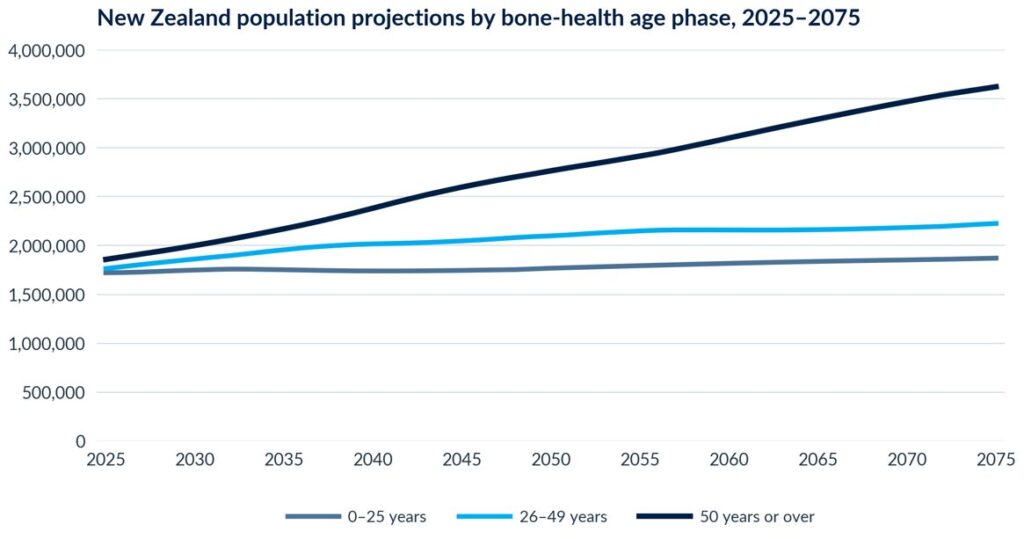
Source: Stronger Together: A Collaborative Strategy for Bone Health in New Zealand.
Against this backdrop, early national data are highly encouraging. Refracture Tracker results published in the 2026 Australian and New Zealand Fragility Fracture Registry (ANZFFR) Annual Report show substantially lower refracture rates among patients managed through New Zealand’s Fracture Liaison Service (FLS) network than the reference curve in the graph below.
What is the early data telling us?
Refracture rates among New Zealand FLS patients are tracking substantially below the international “without universal FLS” benchmark.
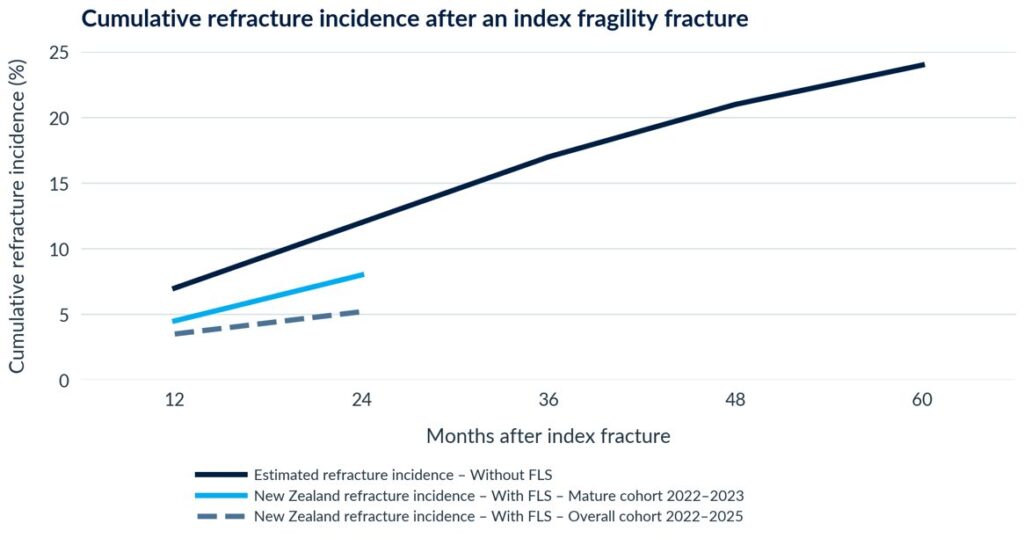
Sources: 2026 ANZFFR Annual Report; graph produced in the third edition of the Clinical Standards for Fracture Liaison Services in New Zealand.
What does the comparison curve mean?
For clarity, the reference curve is not an untreated New Zealand control group. It can be described as a “counterfactual” benchmark derived from international observational studies, estimating what refracture rates might look like without systematic FLS care across the country. The clear separation between the benchmark and the New Zealand results is particularly encouraging because the risk of refracture is greatest during the first two years after a fracture. These findings provide compelling early evidence that coordinated assessment, treatment and follow-up are making a meaningful difference.
Further academic analysis commissioned by ANZFFR is expected to be published towards the end of 2026, providing a more rigorous assessment of the magnitude, statistical significance and clinical relevance of the reported lower refracture rates.
Read the 2026 ANZFFR Annual Report here.
Read the third edition of the Clinical Standards for Fracture Liaison Services in New Zealand here.